
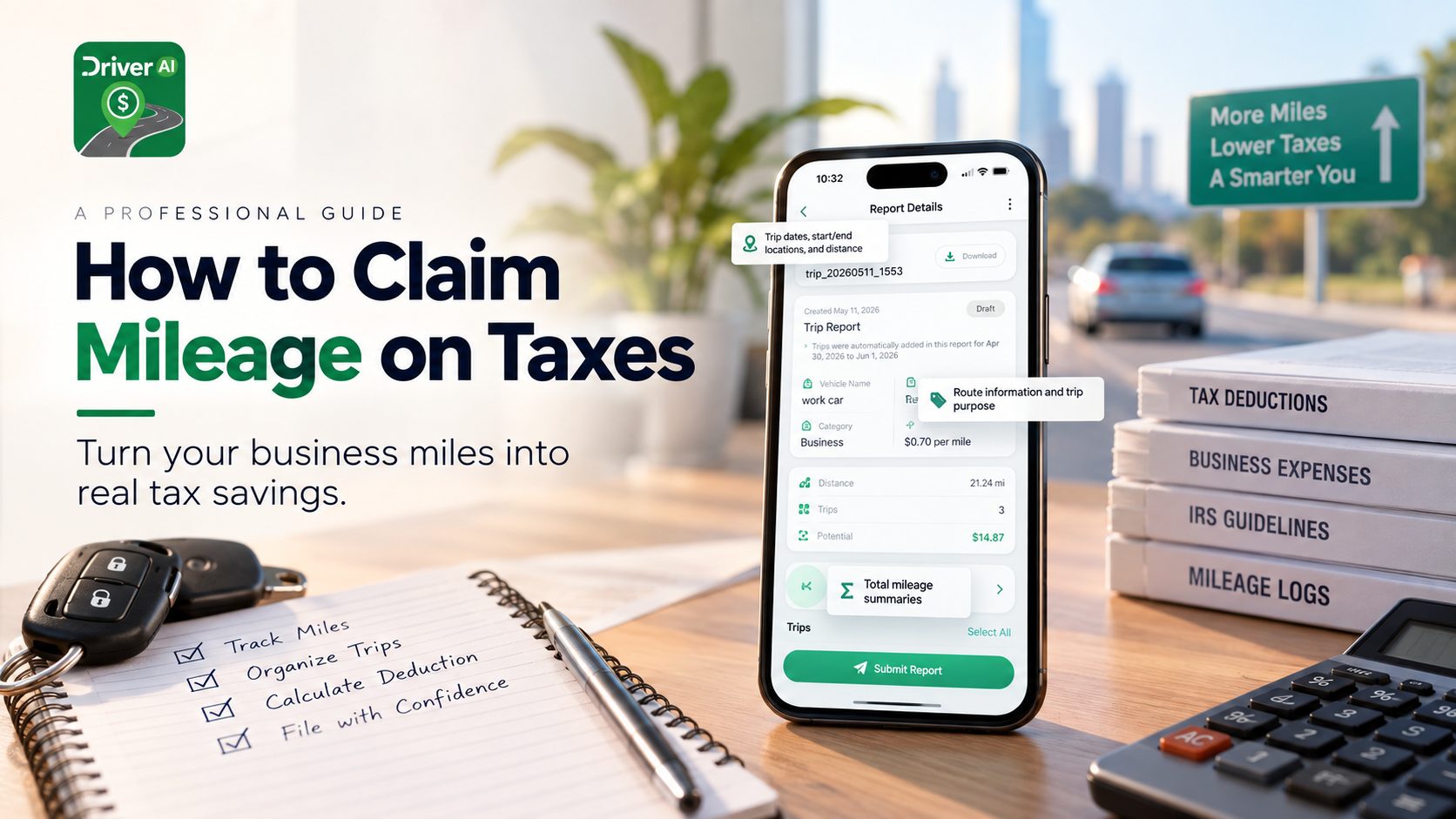
If you use your personal vehicle for business, some of the miles you drive may qualify for a federal tax deduction. Using a reliable mileage tracker for business driving can also make it easier to keep trips organized throughout the year.
For 2026, taxpayers who claim mileage on taxes need extra attention because the IRS changed the standard business mileage rate in the middle of the year. According to the IRS standard mileage rates:
That means taxpayers using the standard mileage method should separate eligible business miles into two periods. This guide explains who may qualify, what counts as business mileage, how to calculate the deduction, what records to keep, and which mistakes to avoid.
Important: This article provides general educational information about U.S. federal taxes and is not personalized tax advice.
2026 IRS Mileage Rates
The IRS publishes optional standard mileage rates for qualifying vehicle use.
| Purpose | Jan. 1–June 30, 2026 | July 1–Dec. 31, 2026 |
|---|---|---|
| Business use | 72.5¢ per mile | 76¢ per mile |
| Medical | 20.5¢ per mile | 23.5¢ per mile |
| Moving | 20.5¢ per mile | 23.5¢ per mile |
| Charitable service | 14¢ per mile | 14¢ per mile |
For most self-employed taxpayers and small-business owners who claim mileage on taxes, the business rate is the most relevant.
How Does the Mileage Deduction Work?
When a personal vehicle is used for business, eligible vehicle costs may be deductible when you claim mileage on taxes. The IRS generally allows two methods:
The IRS Publication explains the rules for travel, transportation, vehicle expenses, substantiation, and recordkeeping. You generally cannot deduct the same underlying vehicle costs twice, so the method you use matters.
Method 1: Standard Mileage Rate
The standard mileage method is usually the simpler option when you claim mileage on taxes. Instead of separately calculating gasoline, insurance, maintenance, repairs, and depreciation, you multiply your qualifying business miles by the applicable IRS rate.

For 2026, use:
Jan. 1–June 30 business miles × $0.725 plus July 1–Dec. 31 business miles × $0.76
Example
Suppose a self-employed consultant drives: 4,000 business miles from January through June; 5,000 business miles from July through December.
Calculation:
A $6,700 deduction does not mean a $6,700 refund. It generally reduces taxable business income, depending on your overall tax situation.
Method 2: Actual Vehicle Expenses
The actual-expense method allows eligible taxpayers who claim mileage on taxes to deduct the business share of qualifying vehicle costs. According to IRS Publication 463, these can include expenses such as:
If the vehicle is used for both business and personal driving, only the business portion is generally deductible.
Example
Suppose your eligible vehicle expenses total $10,000 for the year. You drove: 15,000 total miles; 9,000 business miles.
Actual-expense calculations can become more complex when depreciation, leasing, or mixed-use rules apply.
Standard Mileage vs. Actual Expenses
Standard mileage
- Usually simpler to calculate
- Requires accurate business-mile tracking
- Uses an IRS rate per eligible mile
- Less operating-expense receipt management
- May work well for high-mileage drivers
Actual expenses
- More detailed calculation
- Requires mileage and expense tracking
- Uses the business portion of qualifying actual costs
- Requires more supporting documentation
- May be useful when eligible vehicle expenses are relatively high
The best method to claim mileage on taxes depends on your circumstances and eligibility.
Can You Switch Between Methods?
For a vehicle you own, the IRS generally requires you to choose the standard mileage method in the first year the vehicle is available for business use if you want to preserve the option to use it.
For a leased vehicle, choosing the standard mileage method generally means using it for the full lease period, including renewals.
Who Can Claim Business Mileage?
Business mileage deductions are especially relevant to eligible:
Many sole proprietors who claim mileage on taxes report eligible vehicle expenses on Schedule C.
Can W-2 Employees Deduct Mileage?
In general, the current law does not allow the majority of employees to deduct unreimbursed employee mileage as a federal miscellaneous itemized deduction.
Specific categories of taxpayers may be eligible for specific, restricted exceptions.
Employer mileage reimbursement is a separate issue and depends on the employer's reimbursement arrangement.
What Counts as Business Mileage?
Potential business mileage can include driving:
- Office to client
- Client to client
- Office to supplier
- To a business meeting
- To a job site
- To purchase business supplies
- From a qualifying home office to another work location
To claim mileage on taxes, the trip must have a legitimate business purpose.
The Transportation section of IRS Publication 463 provides detailed examples.
Is Commuting Mileage Deductible?
Generally, no.
Driving between your home and your regular workplace is normally considered personal commuting.
Examples:
Simply making a business call while commuting does not usually make the trip deductible.
What If You Work From Home?
Travel from your qualifying home office to another work location within the same business may be eligible for deductions if it serves as your principal place of business.
However, the home does not automatically become your primary place of business if you work from home on occasion.
Can You Deduct Parking and Tolls?
Qualifying business-related parking fees and tolls may generally be deductible in addition to the standard mileage calculation. For example,
Those expenses may be eligible for deductions on their own. However, parking at your regular workplace as part of your commute is generally personal.
What Records Do You Need?
Recordkeeping is one of the most important parts when you claim mileage on taxes.
A strong mileage record should include:
| Information | Why It Matters |
|---|---|
| Date | Establishes when the business trip occurred |
| Destination | Identifies where the trip went |
| Business purpose | Supports why the trip was business-related |
| Miles driven | Supports the mileage calculation |
| Odometer information | Helps substantiate vehicle usage |
| Related tolls/parking | Supports additional qualifying expenses |
The IRS explains substantiation and recordkeeping requirements in Publication 463.
When Should You Record Mileage?
Ideally, mileage should be recorded at or near the time of the trip when you claim mileage on taxes.
Contemporaneous records are generally stronger than records recreated months later.
That is one reason many business drivers use automatic mileage tracking to reduce manual recordkeeping and keep trip information more consistent.
Can You Use a Mileage Tracking App?
Yes, electronic records can help support business mileage when you claim mileage on taxes, provided they contain the information needed to substantiate the expense.
- ✓Capture trips
- ✓Track miles
- ✓Separate business and personal travel
- ✓Add business purposes
- ✓Maintain trip history
- ✓Generate reports
How to Claim Mileage on Your Tax Return
For many sole proprietors and independent contractors who claim mileage on taxes, eligible vehicle expenses are reported on Schedule C. A simplified process is:
Step 1: Identify qualifying business miles
Separate business travel from personal and commuting mileage.
Step 2: Split 2026 mileage into two periods
Track: Jan. 1–June 30; July 1–Dec. 31
Step 3: Apply the correct rate
Use: First-half miles × $0.725 plus Second-half miles × $0.76
Step 4: Add qualifying parking and tolls
These may be separately deductible when applicable.
Step 6: Keep your records
Retain mileage logs and supporting documentation after you claim mileage on taxes and file your return.
Common Mileage Deduction Mistakes
1. Deducting ordinary commuting
Home-to-regular-workplace mileage is generally personal.
2. Using one rate for all of 2026
72.5¢ per mile for Jan.–June; 76¢ per mile for July–December.
3. Reconstructing mileage from memory
Records created near the time of travel are generally more reliable.
4. Mixing business and personal trips
Not every mile driven by a business owner is deductible.
5. Claiming standard mileage plus duplicate operating costs
You generally cannot use the mileage rate and separately deduct operating expenses already included in that rate.
6. Failing to record business purpose
A mileage total alone is not enough. The business reason for the trip matters.
2026 Mileage Deduction Checklist
Before filing to claim mileage on taxes, make sure you:
- Separate business, personal, and commuting mileage
- Split mileage into the two 2026 rate periods
- Use the correct IRS rate
- Record trip dates
- Record destinations
- Document business purposes
- Track total mileage where needed
- Keep parking and toll records
- Maintain expense documentation if using actual expenses
- Complete the correct tax forms
- Retain supporting records
Final Takeaway
When you claim mileage on taxes, mileage can be a meaningful business deduction, but accurate classification and recordkeeping matter.
For 2026, remember the mid-year rate change: January 1–June 30: 72.5¢ per business mile; July 1–December 31: 76¢ per business mile
Keep business and personal trips separate, document the purpose of qualifying travel, and maintain records throughout the year.